
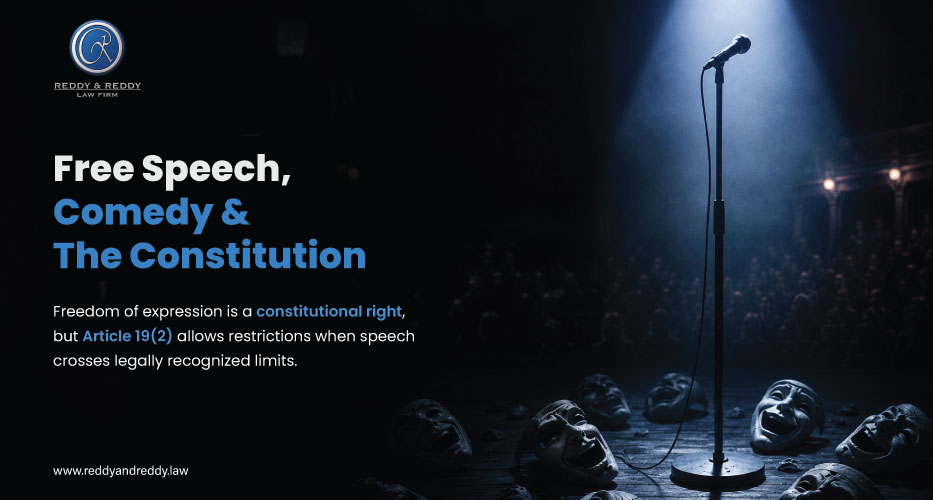
As we all are aware, the Constitution of India is a document which is often referred to as the Law of the Land. The said robust document encompasses a range of pivotal provisions entrusted to the people of India by virtue of their being citizens of this country.
One such provision is Article 19(1)(a) of the Constitution, which protects the freedom of speech and expression. The provision covers within its ambit the freedom to political speech, artistic expressions, satire, comedy, films and digital content. However, it is pertinent to note that the rights entrusted upon the citizens are not absolute; rather, they are accompanied by reasonable restrictions. Article 19(2) permits reasonable restrictions, inter alios, in the interest of public order, decency and morality.[1]
In recent times, the constitutional difficulty lies in ensuring that the fine line between the freedom given and the restrictions imposed are maintained.
INDIA’S GOT LATENT: A STUDY
India’s Got Latent’s recent controversy is therefore not merely about one comedian or one episode or one line used in the show. It illustrates the vulnerability of digital creators where one controversial clip can trigger criminal complaints, removal of other content of the same person online, expensive legal coupled, coupled with a media trial whereby the content creator is held guilty.[2]
The reported appearance of an eleven-member legal team for the latest season of the show caught everyone’s eye; for the same is significant not because it slightly portrays the practical cost of exercising freedom of speech in the country.[3]
DECENCY, MORALITY AND OBSCENITY: THE FINE LINE
The vital constitutional grounds relevant to the show’s controversy are those of “decency” and “morality” as detailed in Article 19(2). However, it is worthwhile to understand that these terms cannot be treated as a license for subjective censorship.[4]
The episode of India’s Got Latent which attracted criticism involved allegations that sexually explicit remarks crossed the line into obscenity and offended public morality. The said allegations warranted legal examination rather than a media trial.
The fact that speech is crude, vulgar or offensive does not by itself answer the constitutional question. The State must still show that the proposed restriction is reasonable and genuinely connected to decency, morality, public order or another permitted ground.[5]
LEGAL LIMIT OF ROAST COMEDY
It is pertinent to understand that the form of comedy in the show is popularly known as Roast Comedy, which deliberately uses exaggeration, insult, discomfort and crude language. The purpose is often to challenge social conventions rather than conform to them. Therefore, it cannot be judged only on isolated facets involved in this form of comedy, for instance, the language.[6]
The Hon’ble Supreme Court in the case of S. Rangarajan v P. Jagjivan Ram, in unequivocal terms held that freedom of expression cannot be suppressed merely because there is a threat of protest or opposition. The anticipated danger must be proximate and real, not remote or speculative.[7]
The above quote principle is quite relevant to digital comedy because viral outrage often produces immediate action in the form of censorship even before the content and the context in which the content was used are assessed.
It is equally true that roast comedy is not immune from legal scrutiny. Where the content crosses into legally obscene material, targeted harassment, defamatory
The constitutional balance is not between “complete freedom” and “complete censorship”; it is between lawful artistic expression and speech that clearly falls within a recognised exception, hate speech or such like, Article 19(2) may be attracted.[8]
LEGAL ACCOUNTABILITY & CHILLING EFFECT
One of the strongest constitutional concerns that was raised by the India’s Got Latent controversy is the chilling effect of criminal process. Even before the issue reached the appropriate judicial or quasi-judicial forum, there was a burden of FIRs’ police summons’ and public controversy demanding the creator to be punished or more outcasted.[9]
The Hon’ble Supreme Court in the case of Shreya Singhal v Union of India had categorically recognised that vague and overboard restrictions on online speech can end up producing a chilling effect; thereby discouraging people from expressing lawful views due to the fear of prosecution should their views be considered offensive. [10]
The reported robust eleven-lawyer legal team for the new season of the show is a first clearest practical example in this regard. The said step is an example that creators now perceive a high legal risk in publishing edgy content. Lawyers may review scripts, obtain participant consents, assess defamation and obscenity risks, and prepare for mitigating any potential litigation. Such compliance is legitimate; however, when it becomes necessary for every joke that challenges social norms, it may transform free expression into heavily regulated one.[11]
CONCLUSION
It would not be inappropriate to mention that the entire India’s Got Latent controversy is ultimately not about whether comedians should enjoy unrestricted freedom. It is about the legal conundrum of whether constitutional rights can be weakened by practical burdens associated with exercising them.[12]
The State unequivocally possesses the authority to act against genuinely obscene or unlawful content. However, Article 19(2) cannot become an expensive moral filter through which every offensive joke is treated as criminal. The proper test is whether the content, viewed in its full context, clearly falls within a constitutionally permitted restriction.
The constitutional task is, therefore, is to preserve a principled boundary: speech may certainly be restricted, but only when it squarely falls within the ambit of defined exceptions under the provisions of Article 19(2), and not merely because it is unpopular or non-conventional.[13]
References
[1] The Constitution of India, art 19 (1), 19 (2)
[2] LawCurate Editor’s Desk, ‘India’s Got Latent: Returns for season two with an 11-member legal team’ (LawCurate, 26 June, 2026) https://lawcurate.in/indias-got-latent-returns-for-season-two-with-an-11-member-legal-team/ accessed 8 July 2026
[3] ibid
[4] Himanshu Poshwal, ‘”Article 19(2) vs. The Right to Roast: Legal Limits of Satire in Samay Raina’s India’s Got Latent”’ (Legal Maestros, 23 June, 2026) <https://legalmaestros.com/uncategorized/article-192-vs-the-right-to-roast-legal-limits-of-satire-in-samay-rainas-indias-got-latent/> accessed 8 July 2026
[5] ibid
[6] Nathana L Bright, ‘Comedy And The Art of the Roast’ (Edge Induced Cohesion, 23 March 2011) https://edgeinducedcohesion.blog/2011/03/23/comedy-and-the-art-of-the-roast/ accessed 7 July 2026
[7] S Rangarajan v P. Jagjivan Ram & Ors. [1989] SCC 574
[8] Epil Bodra, ‘India’s Got Latent: A Caution for India’s Digital Ecosystem’ (Ascendants, 8 July 2026) https://ascendants.in/industry_events/indias-got-latent-a-caution-for-indias-digital-ecosystem/ accessed 8 July 2026
[9] ibid
[10] Shreya Singhal v Union of India [2015] 5 SCC
[11] Ibid 2
[12] Ibid 4
[13] Ibid 4
BIBLIOGRAPHY
Legislation: Constitution of India, arts 19(1) and 19(2).
Cases
- Shreya Singhal v Union of India [2015] 5 SCC 1.
- S Rangarajan v P Jagjivan Ram [1989] 2 SCC 574.
Secondary Sources
- Bright NL, ‘Comedy and the Art of the Roast’ (Edge Induced Cohesion, 23 March 2011) https://edgeinducedcohesion.blog/2011/03/23/comedy-and-the-art-of-the-roast/ accessed 7 July 2026.
- Bodra E, ‘India’s Got Latent: A Caution for India’s Digital Ecosystem’ (Ascendants, 8 July 2026) https://ascendants.in/industry_events/indias-got-latent-a-caution-for-indias-digital-ecosystem/ accessed 8 July 2026.
- LawCurate Editor’s Desk, ‘India’s Got Latent: Returns for Season Two with an 11-Member Legal Team’ (LawCurate, 26 June 2026) https://lawcurate.in/indias-got-latent-returns-for-season-two-with-an-11-member-legal-team/ accessed 8 July 2026.
- Poshwal H, ‘”Article 19(2) vs the Right to Roast: Legal Limits of Satire in Samay Raina’s India’s Got Latent”‘ (Legal Maestros, 23 June 2026) https://legalmaestros.com/uncategorized/article-192-vs-the-right-to-roast-legal-limits-of-satire-in-samay-rainas-indias-got-latent/ accessed 8 July 2026
