
NINE YEARS, NO DECISION: INDIA’S POSITION IN THE DEBATE AROUND ISDS REFORM
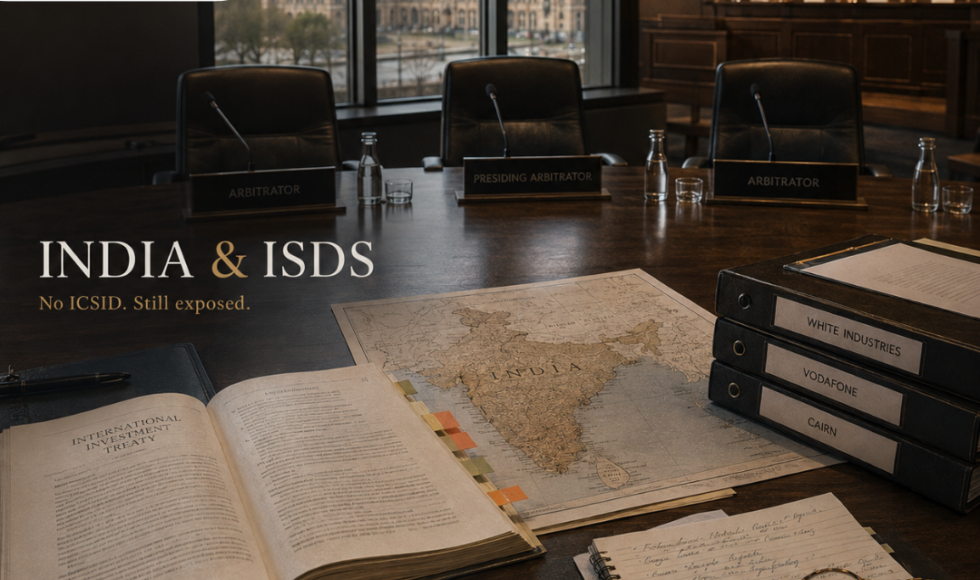
Investment Arbitration is a mechanism to bring claim by a foreign investor against a host state. It moves away from a long drawn diplomatic procedure by a domestic government, to a shorter and fast paced version of settlement, whereby a settlement occurs because of a breach of protection owed to the investor under a treaty or a contract, while the state is exercising its regulatory or public power. This is the main differential structure with respect to Commercial Arbitration where both parties are private investors. In contrast, Investment Arbitration includes a sovereign state, even a state-owned entity can be a party. Investment arbitration operates through several distinct institutional frameworks, each with its own procedural character. The International Centre for Settlement of Investment Disputes (ICSID), established under the 1965 ICSID Convention as part of the World Bank Group, offers a self-regulatory system. India presents a different position, the country has never ratified that ICSID Convention, placing the country out of World Bank’s Investment Arbitration framework. However, disputes proceed under the UNCITRAL Arbitration Rule, under Permanent Court of Arbitration at The Hague. This route was followed by White Industries Australia Ltd. v. Republic of India (2011), Vodafone International Holdings B.V. v. India, and Cairn Energy PLC v. India. India depends on the 1958 New York Convention, under which domestic court holds certain limited grounds, whereby they may resist enforcement through Public Policy.
BACKGROUND
Investor-State arbitration was once an unassuming instrument of law. Since the 1960s, states inserted arbitration provisions in bilateral investment treaties with the sole intention of assuring foreign investors that in case the host state would expropriate their investment or act in a discriminatory manner against them, then investors would have access to an impartial forum for their grievances without having to rely on diplomacy. Nothing much happened until NAFTA, with the flood of landmark cases demonstrating that the protection granted by such agreements was broader than anyone had initially thought: not only did the provisions extend to cases of expropriations, but to regulatory actions that merely devalued an investment, and ambiguous standards such as fair and equitable treatment.
The backlash that came in response was twofold. The first wave was generated by Latin America, specifically because Argentina’s early-2000s financial crisis spawned an unprecedented number of ISDS claims there, reinforcing the feeling of structural unfairness in the eyes of developing nations. The second wave was triggered by the so-called “tobacco cases” with Philip Morris suing Uruguay for anti-smoking measures and threatening similar action in Australia. In response, the latter announced that from 2011 on ISDS would not be part of Australia’s new international treaties. And finally, the debate moved to Europe. After the Vattenfall dispute with Germany regarding its nuclear phase-out policy, as well as launch of the Transatlantic Trade and Investment Partnership (TTIP) negotiations between the EU and the US, ISDS became the most politically contentious part of this negotiation process. Amid massive public protests, the EU tabled a completely novel proposal in November 2015 – an “Investment Court System” with fixed and publicly appointed judges and an appeal mechanism, which replaced ISDS completely.
WORKING GROUP III REFORMS
The same approach was used by the EU at the international level and, in July 2017, the United Nations Commission on International Trade Law assigned mandate to its Working Group III to assess issues related to ISDS, determine whether reform is needed and design solutions. By November 2018, the Working Group has identified six fundamental issues: high costs, delay, inconsistency of awards, questionable correctness of decisions, lack of diversity among arbitrators, and the question of arbitrator’s independence. A number of incremental reforms were implemented, namely, in 2023, there was adopted the Code of Conduct for Arbitrators and established the Advisory Centre to help developing states. However, the crucial issue of structure of ISDS was not addressed: either ISDS system should be based on ad hoc tribunals with each party choosing the arbitrator on a case-by-case basis, or it should be based on a standing multinational investment court with appointed judges and appeal procedure? The EU has proposed the second option since 2017; the arbitration community, through such organizations as EFILA, has been opposing it as revolutionary change which deprives investors of their right to choose who would decide the case and destroys the finality of arbitration. The question was deferred again in January 2026 and became the central agenda item that March still unresolved nine years on. It is more than simply being an argument about process. Conflicts of interests emerge because arbitrators act not only as arbiters but also as representatives of someone else; tribunals differ regarding the same facts; there are no precedents; costs are exorbitant in time and money; and ISDS is increasingly being used to challenge environmental, public health, and tax policies. Nine years have passed with no resolution being reached.
INDIA’S QUIET STANCE
India’s stance on ISDS is complicated, and misunderstood too since India did not sign onto the ICSID Convention. The sole fact in itself is taken to mean that reform on ISDS is not relevant to Indians at all. That is not necessarily true. India is equally exposed to ISDS: Indians have been sued many times before in White Industries (2011), Vodafone, and Cairn Energy, cases in which dispute has been administered via UNCITRAL Arbitration Rules and the Permanent Court of Arbitration located at The Hague. Contrary to what its name implies, the Permanent Court of Arbitration is not a tribunal but an administrative body whose only function is to appoint arbitrators and manage logistical needs. That is why India’s continued use of the PCA is not in tension with the EU’s proposed standing court, the PCA changes nothing about who decides the case, while a standing court would remove India’s ability to appoint its own arbitrator and replace it with a fixed salaried bench India never selected.
India, has long pushed for reforms within the WGIII, but when the group met in January 2026, India, along with Russia and Thailand, all of which are non-ICSID members, blocked the proposal to allow non-dispute parties to intervene in other countries’ dispute cases as well, reportedly on the basis of India’s experience in the WTO regime rather than ISDS proceedings themselves. Such conduct is the opposite of that of a country aligned with a certain side; it is a case-by-case calculus. It was the very same thinking that led to India’s Model BIT of 2016, developed post-White Industries case, which mandates that investors must exhaust domestic remedies for five years and limits fair-and-equitable-treatment provisions. In both domestic and international arenas, the logic is consistent: India is averse to having any international entity, be it ad hoc or specially constituted court, determine its regulatory measures.
~Mohammed Nawed
ILS Law College
II Year LL.B.
